FC Bayern Munich is a sports club based in Munich, Bavaria, Germany. They are best known for their football team which plays in the Bundesliga. They are the most successful football club in German football history, having won 26 national Championships and 18 national cups.
Bayern Munich were founded in 1900 by a group of football players led by Franz John. They won their first national Championship in 1932 but weren’t selected for the Bundesliga for its inception in 1933. Their greatest period of success was in the 1970’s under the captaincy of Franz Beckenbauer.

FC Bayern Munich History
Origins of FC Bayern Munich can be traced back to members of a Munich gymnastics club (MTV 1879) who, on being told in 1900 that they could not join the German Football Association (DFB) left to set up their own club. They were immediately successful with some huge victories over local rivals and having won local trophies they joined the newly-formed “Kriesliga” in 1910-11, which was the first regional Bavarian league. They won the league in its first year but didn’t win it again before the start of World War I in 1914 when all football activities were halted in Germany.
In the early interwar years, Bayern won several regional competitions before winning the South German championship in 1926 and 1928. They won their first national title in 1932, beating Eintracht Frankfurt 2-0 in the final.
The rise of Nazism in Germany put paid to a lot of FC Bayern Munich’s ambitions though. Derided as being “the Jew’s club” due to Club President Kurt Landauer and their coach both being Jewish, FC Bayern Munich suffered as both fled the country. Many others within the club were purged, and local rival 1860 Munich gained much support. Josef Sauter, who was inaugurated as president in 1943 was the only member of the NSDAP to hold that position within the club. Bayern were also affected by a ruling that all football players had to be amateur once again.
After the war, Bayern became a member of the Oberliga Sud, the southern conference of the German top tier. These were times of struggle for FC Bayern Munich, with the Bavarian side going through 13 coaches in a period of 18 years between 1945 and 1963. While Landauer had returned to Germany to be the club president once again to give the club some continuity, FC Bayern Munich were relegated in 1955. They bounced back to promotion the next season and won the DFP-Pokal (German FA Cup) for the first time in 1956-57, beating Fortuna Dusseldorf in the final.
When in 1963 the Oberligas were consolidated into one league, Bayern missed out once again. While they finished in the top three of the Oberliga Sud and five teams from that conference were admitted into the new Bundesliga, 1860 Munich had won the title and the DFB were loathe to take more than one team from each city. Bayern gained promotion two years later, thanks to a team of young talents including Franz Beckenbauer, Gerd Muller and Sepp Maier. “The axis” as they became known were central to Bayern’s success over the next decade.
In their first season in the top flight FC Bayern Munich came third and won the DFB-Pokal. The cup victory saw them qualified for the following year European Cup Winners’ Cup, which they won in extra time against Rangers when Franz Roth scored the only goal of the game. Under Branko Zebec, Bayern introduced a disciplined approach to their style of play and in 1969 became the first ever German team to win the Bundesliga/DFB-Pokal double. In that season Zebec only used 13 players.
Bayern won the Championship in 1971-72. The deciding match that season was the first match Bayern played in their new home, the Olympiastadion and the first televised match in Bundesliga history. Bayern beat Schalke 5-1, setting records for points gained and goals scored in a season.
FC Bayern Munich went on to win the title in the following two seasons but the zenith of their achievements was the 1974 European Cup final, in which they beat Atletico Madrid 4-0 after a replay. While the club was unsuccessful in the years that followed domestically, they defended their European Cup title in 1975, beating Leeds United in the final. In 1976, Bayern became the third team to win the European Cup in three consecutive seasons, beating St Etienne in the final in Glasgow. The final trophy Bayern won in this era was the Interncontinental Cup, which they won beating Cruizeiro over two legs. The remainder of the decade was a time of change, with Beckenbauer moving to New York Cosmos in 1977 and Gerd Muller moving to the Fort Lauderdale Strikers in 1979.

Bayern went on to reassert their dominance in German football in the latter half of the 1980s, winning five Bundesliga titles in six seasons between 1984 and 1990 including a double in 1986. However, it wasn’t until 2001 that Bayern would see success return on the European stage, when they beat Valencia on penalties to win the Champions League.
Since 2000 Bayern have been the dominant force in German football, winning the title ten times between 2000 and 2016. In the four year spell between 2012 and 2016 Bayern won the title four times consecutively, including back-to-back doubles in 2014-15 and 2015-16. In all, Bayern have won the domestic double eight times in sixteen seasons since the turn of the millennium. They also won the Champions League, UEFA Super Cup and FIFA World Club Cup in 2013, making it five trophies in all won that season.
Bayern Munich next matches
FC Bayern Munich Jersey
The original FC Bayern Munich jersey was to be blue and white (the colours of Bavaria) as per the original constitution of the club, but the club actually played in white shirts and black shorts until 1905, when Bayern joined the Münchner Sport-Club (MSC) in 1906 they were told that they had to play games in red shorts.
For much of the club’s early history, Bayern wore primarily white and maroon home kits. In the 1968-69 season, they changed to red and blue striped shirts with blue shirts and blue socks. In the seasons that followed they switched to red and white stripes with either red or white shorts and red socks. They then switched to an all-white kit in 1973-74, before switching again from 1974 onwards to all red.
The red and blue striped colour scheme was revived between 1995 and 1997, along with a new predominately blue kit in 1997 for home games. There was also a revival of the “Rotwein” coloured kits between 2001 and 2003.
FC Bayern Munich Logo
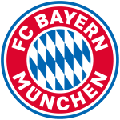
The crest of FC Bayern Munich has changed several times. Originally, the crest consisted of stylised letters F, C, B and M woven into one symbol. The original colour was Blue, with the colours of Bavaria introduced for the first time in 1954.
The FC Bayern Munich logo continued to evolve, with the name “Bayern” originally above the Bavarian colours in a circle before 1970 when the logo was changed so that the words FC Bayern Munchen EV encircled the colours. The latest update to the logo occurred in 2002 when the letters EV were removed and the blue in the logo was lightened.

FC Bayern Munich Roster
There have been many notable FC Bayern Munich players over the years. The 1970s were undoubtedly the first glory years for Bayern. The team of that era included German stars Sepp Maier in goal; Franz Beckenbauer and Hans-Georg Schwarzenbeck in defence, Paul Breitner and Franz Roth in midfield along with Gerd Müller and Uli Hoeneß up front.
The 1980s FC Bayern Munich line-up had players like defender Klaus Augenthaler and forward Karl-Heinz Rummenigge while in the 1990s they could call upon midfielders Steffen Effenberg and Lothar Matthäus.
In the 2000s the team became more cosmopolitan, with French defender Bixente Lizarazu and Brazilian forward Giovane Elber rubbing shoulders with German legends Oliver Kahn and Mehmet Scholl.
The all-conquering team of the 2010s include one of the world’s best goalkeepers Manuel Neuer, German stars Mats Hummels, Philipp Lahm and Thomas Müller along with Polish legend Robert Lewandowski.
https://www.flickr.com/photos/williambrawley/4709393221/
https://www.flickr.com/photos/jaschau/14515999010/
https://www.flickr.com/photos/24736216@N07/3370592296/
CC BY-SA 2.0, https://creativecommons.org/licenses/by-sa/2.0/
Upcoming Sport Events
Latest News
 vs
vs
Las Palmas vs Malaga Prediction [LaLiga 2 | 2026-06-07]
Predictions
 vs
vs
CR Brasil vs Sao Bernardo Prediction [Brasileiro Serie B | 2026-06-07]
Predictions
 vs
vs
Cerro vs Penarol Prediction [Primera Division | 2026-06-07]
Predictions
 vs
vs

Chwalinska, Maja vs Andreeva, Mirra Prediction [French Open Women Singles | 2026-06-06]
Predictions
 vs
vs
Ranheim vs Strommen Prediction [1st Division | 2026-06-07]
Predictions
 vs
vs

Progreso vs Albion Prediction [Primera Division | 2026-06-07]
Predictions
 vs
vs
Club Joventut Badalona vs Baskonia Vitoria-Gasteiz Prediction [Liga ACB | 2026-06-05]
Predictions
 vs
vs

Chicago Wolves vs Colorado Eagles Prediction [AHL | 2026-06-06]
Predictions
 vs
vs
Toronto Marlies vs Wilkes-Barre/Scranton Penguins Prediction [AHL | 2026-06-05]
Predictions
 vs
vs